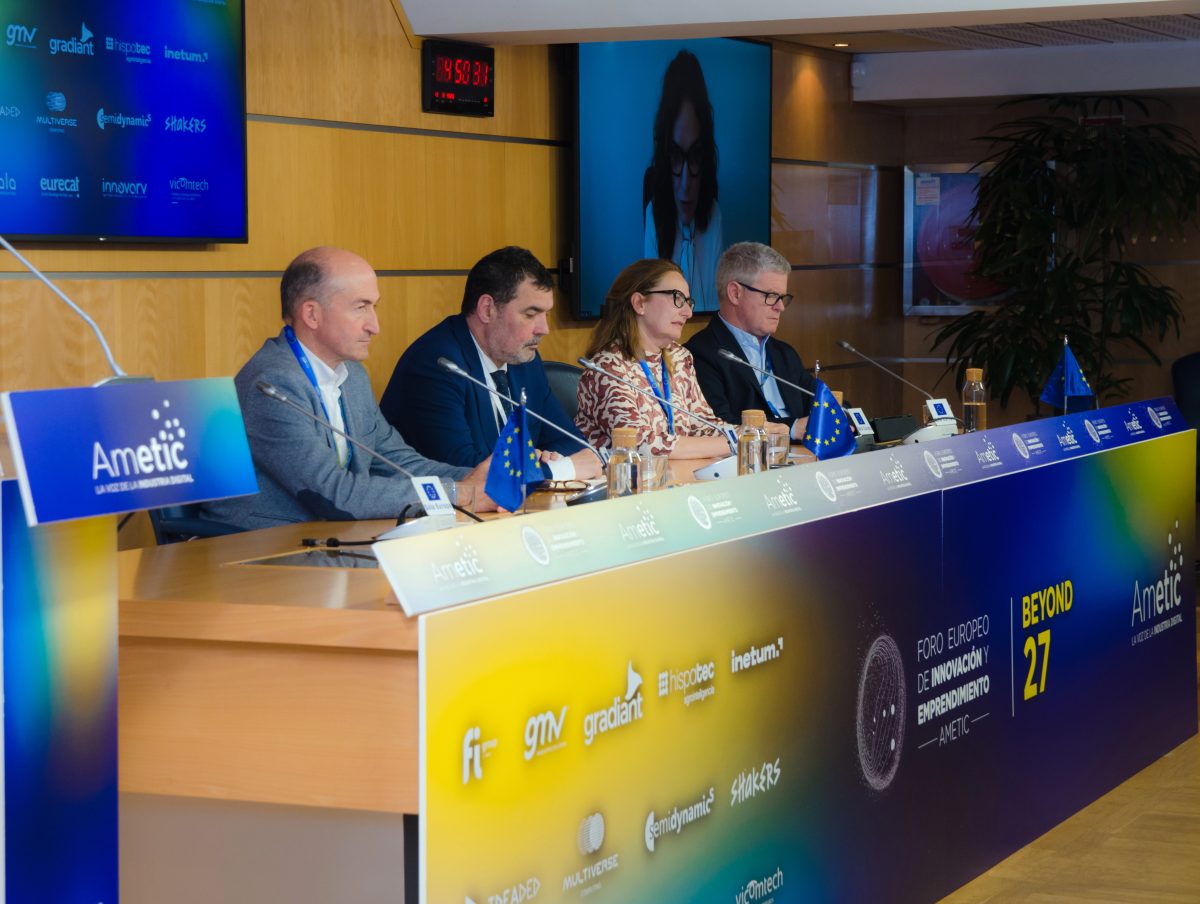
Europe is beginning to shape the Multiannual Financial Framework (MFF) for 2028-2034 and the funding programmes that will sit beneath it. Against a backdrop of pressure on the EU budget, the debate is already centring on two key questions: how to preserve excellence and independence as core selection principles in the next Framework Programme, widely referred to as FP10, and how to ensure effective coordination between Horizon Europe and the future European Competitiveness Fund (ECF). Those issues were at the heart of a panel moderated by Zabala Innovation during the first European Innovation and Entrepreneurship Forum, organised by Ametic, Spain’s digital industry association, on 19th March at the European Commission and European Parliament offices in Madrid. The discussion focused on the place of innovation in the next EU budget cycle and on how public support can accompany projects from research through to market deployment.
The session brought together MEP Lina Gálvez Muñoz, Javier García Serrano, Head of Department at CDTI, Spain’s public agency for innovation funding and technological development, and José Luis Molina, Chief Executive of Hispatec, a Spanish agri-tech company. The panel was moderated by Camino Correia, Director of European Programmes at Zabala Innovation, with Seán Gaines, Director of International Projects at Vicomtech, a Spanish applied research and technology centre specialising in digital technologies, contributing as challenger.
Budget, excellence and autonomy
Correia stressed the scale of what is now on the table in Brussels. The figures currently being discussed would channel roughly a quarter of the next MFF into Horizon Europe, with a budget of €175 billion, and the new ECF, with €234 billion, a level she described as a major political bet on innovation.
Gálvez framed the discussion in political terms. He recalled that the European Parliament is already working on the amendments to FP10 and the new fund, with a view to reaching plenary in October, and warned that the negotiations will be complex because of the pressure on the budget. He argued for an ambitious budgetary framework for FP10 and stressed that “the criterion of excellence in the Horizon Europe programme cannot be abandoned”.
She also argued that Horizon Europe and the future ECF should have separate, though coordinated, work programmes, particularly to help translate results emerging from Pillar II of the Framework Programme. In her view, the autonomy of both the European Research Council and the European Innovation Council should be preserved, while research funding should not be diverted towards priorities unrelated to research and innovation. Governance, she suggested, will need to combine institutional oversight with input from people who understand the technological frontier, an approach consistent with the recommendations set out in former Italian prime minister Mario Draghi’s 2024 report on European competitiveness.
Governance and support for scale-ups
From an implementation perspective, García broadly welcomed the direction of travel but warned that research and innovation policy should not become subordinate to industrial policy. Collaborative projects and the Framework Programme, he argued, remain central access routes to EU funding for many organisations, and the new architecture will need governance capable of ensuring coordination across the four policy windows envisaged for Horizon Europe and the ECF, as well as with the wider MFF and the member states. Too much flexibility in how funds are used, he warned, could come at the expense of predictability.
Bringing the debate closer to the business perspective, Correia argued that one of the central challenges in the next framework will be “to create instruments that help innovative technology companies to emerge, grow and remain in Europe”. Molina took the same argument further, saying the ECF should focus squarely on businesses and provide preferential support for innovative tech firms with the capacity to scale. Europe, he argued in essence, “does not lack start-ups; it lacks scale-ups”. He also called for business leaders to be heard when research and innovation support instruments are designed and warned against a kind of paper excellence in which projects perform well in formal evaluations without achieving real market uptake.
Deployment, finance and balance
Gaines brought in a concern shared by many technology centres: that the focus could shift away from projects themselves and towards member states and policy windows. Research alone, he suggested, is not enough; what matters is deployment. He also pointed to the evolution of blended finance within FP10 as a development that deserves close attention.
García responded that the move from pure grants towards equity-based and blended finance instruments has already begun under Horizon Europe, and that companies are now better prepared for these schemes. The real test, he said, will be whether Europe can design a programme that is both attractive and easy to understand. Molina reiterated that impact should be assessed in market terms, not only through the formal quality of proposals, while Correia brought the discussion back to a broader question: how to protect innovation budgets in an increasingly volatile and demanding geopolitical environment.
The panel repeatedly returned to the need for balance. Gaines pointed to a rapidly changing international environment that is fuelling calls for greater budget flexibility. Molina cautioned that flexibility can quickly become instability if it is not clearly framed. García noted that if Europe wants to move closer to the level of combined public and private research and innovation investment highlighted by Draghi – €800 billion a year – it will need more public money. Gálvez closed with a warning on talent: the EU cannot afford to lose human capital, especially women, from scientific and technological careers.