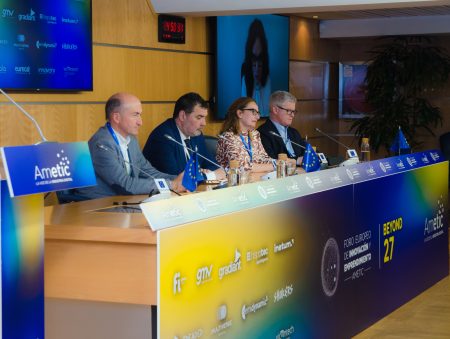
Negotiations on the European Union’s next Multiannual Financial Framework (MFF) for the 2028-2034 period are entering a key phase. In the words of Camino Correia, director of European Programmes at Zabala Innovation, although there is not yet a definitive proposal, “the initial working documents and the positions expressed by the European institutions allow us to say that Europe wants to strengthen its capacity to invest in research, innovation, competitiveness and industrial transformation”. The final scope of this effort, however, still depends on complex negotiations between the Member States, the European Commission and the European Parliament, which are expected to conclude in December.
FP10 points to a 30% increase compared with Horizon Europe
In the negotiations currently led by the Cypriot Presidency of the Council of the EU, the scenarios being discussed for the framework programme, FP10, are below the €175 billion proposed by the European Commission and the €200 billion defended by the European Parliament. Among the figures circulating in the debate is an allocation close to €141 billion, although the Council has not yet adopted a definitive position. Nevertheless, “even in this scenario, the underlying message remains positive”, says Correia, “as this figure would represent an approximate 30% increase compared with the current Horizon Europe programme, which has a budget of around €95 billion”.
In other words, although the institutions disagree on the exact level of ambition, all the reference points place the next framework programme above the current budget. “Research and innovation will remain a strategic priority for the EU in the next decade”, Correia concludes.
The new driver of European competitiveness
Another of the most sensitive debates concerns the creation of the European Competitiveness Fund, one of the instruments expected to carry the greatest weight in the next EU budget. According to the figures currently being discussed in the negotiations, this fund would have an allocation of around €200 billion. Its aim will be to concentrate resources to strengthen European industrial and technological competitiveness, supporting areas such as the clean transition, industrial decarbonisation, health, biotechnology, digital leadership, defence, space and other strategic fields.
The logic behind this new fund responds to the need to improve Europe’s ability to turn knowledge into innovation, innovation into industry, and industry into global leadership. In recent years, the EU has identified structural difficulties in scaling technologies, attracting private investment, consolidating strategic value chains and competing with other major economies. In Brussels’ intentions, the European Competitiveness Fund is being created to respond to this challenge by better connecting research, innovation, industrial deployment and the market.
Its final design is also under negotiation. The Member States want to play a more significant role in the fund’s governance, particularly in defining priorities, work programmes, calls for proposals and budget allocations. “This greater national influence is expected to coexist with safeguards to preserve essential principles of European research and innovation programmes, such as scientific excellence, independent evaluation and open competition”, according to Correia.
A new model for cohesion funds
As regards ERDF funds, “the proposed reform does not imply their disappearance”, Correia assures. What is being discussed is a change in the way they are managed. Instead of maintaining the current architecture, fragmented across multiple programmes, the European Commission has proposed moving towards a single national plan for each Member State, bringing together different instruments financed under shared management.
This new model aims to simplify planning, improve coordination between national and European priorities and increase the capacity to respond to economic, geopolitical or climate crises. In practice, each country would draw up a national strategic plan integrating funds and policies that are currently separate, including cohesion, agriculture, fisheries, climate and other instruments. ERDF funds would therefore not disappear, but would be integrated into a broader and more centralised architecture.
This proposal is generating debate, especially in countries with decentralised territorial structures, such as Spain and Belgium. Regions fear losing visibility or decision-making capacity in the management of funds. The European Parliament has also expressed reservations about the risk of reducing transparency, democratic oversight and the role of territories. For this reason, “one of the major points in the negotiations will be to find a balance between simplification, effectiveness and regional participation”, Correia stresses.
An agreement still to be built
Negotiations on the next EU budget remain open, and positions among Member States continue to diverge. Some countries defend greater budgetary discipline and have proposed adjustments or cuts of between 2% and 4% across different budget headings. Others argue that the new European priorities should not be financed at the expense of traditional policies such as cohesion or agriculture.
“The path towards concluding the negotiations will be demanding”, according to Correia’s forecast. Decisive issues remain to be resolved, such as the final size of the budget, the financing of the new priorities, the role of the Member States, the relationship between FP10 and the European Competitiveness Fund, and the protection of traditional policies. Nevertheless, “the overall reading, despite the complexity of the process, is constructive”, this expert states. “Europe is debating how much to increase its ambition, not whether it should do so. The figures on the table confirm that research, innovation, competitiveness and cohesion will continue to occupy a central place in the future of the European Union”, Correia concludes.